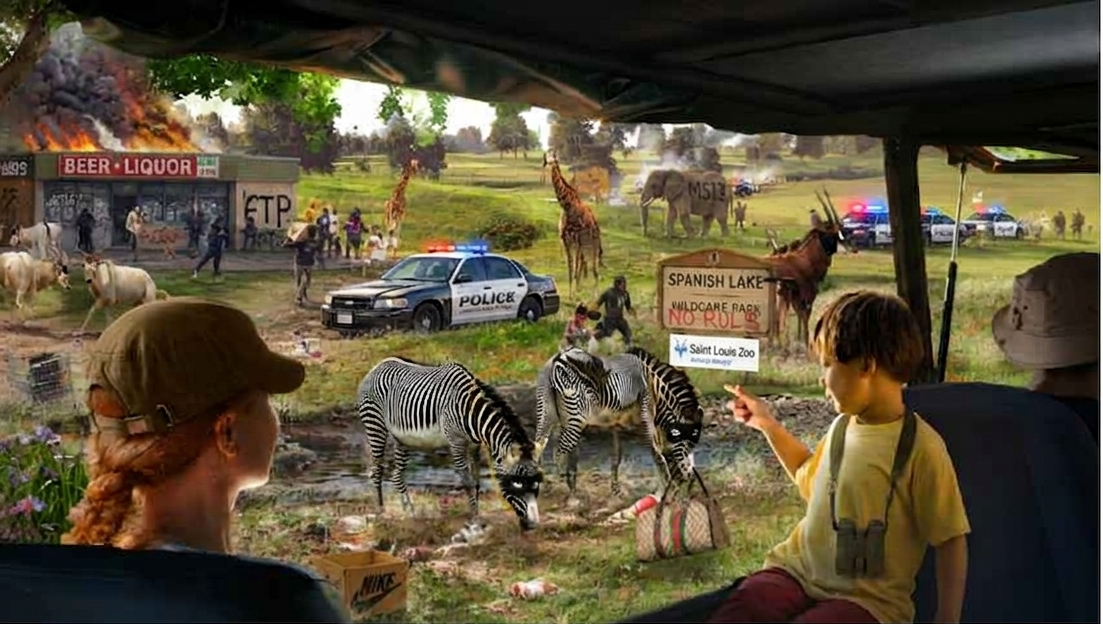
It appears the Powers-that-Be at the Saint Louis Zoo are betting that, next year, your average St. Louis Dad will pile his wife and kids into the family SUV and decamp for the wilds of Spanish Lake (wherever the heck that is) to visit the Zoo’s spanking new $230 million, 425-acre WildCare Park.
Once there, they will ride through the park on trams, as if they’re on safari in the Serengeti, not Spanish Lake.
Zoo officials assure me that this mysterious “Spanish Lake” is somewhere in north St. Louis County and currently has no connection whatsoever to Spain. I’ll have to take their word for it, because I am none-too-familiar with that part of our metropolitan area. However, I do vaguely recall the name mentioned on the news, usually in connection with phrases like “drug market”, “three stabbed” or “body found floating.”
Now I’m no bigot but I would imagine people other than myself are going to be a bit hesitant to drive up to an area of town where they are uncertain whether the most dangerous predator they’ll encounter is a rhinoceros or the fellow in the Chrysler 300 with blacked-out windows following too closely behind them.
And what exactly are we supposed to tell our children when we take them to the top of the 11-story high Observation Tower in this new WildCare Park?
“Look, kids! Over there is a majestic herd of antelope! And over there is a catalytic converter theft in progress!”
It seems to me the Zoo has failed to fully consider the unique challenges of placing exotic wildlife in such an environment.
For example, what measures are being taken to prevent the giraffes from developing an unhealthy fascination with expired temporary license plates?
Zoo officials insist that the animals will be perfectly safe. I certainly hope so. After all, some of these creatures may become quite rare.
I am speaking, of course, of the visitors.
Only time will tell whether WildCare Park becomes the crown jewel of North County or merely the world’s first zoological exhibit where visitors occasionally ask park rangers whether the lions should remain inside the enclosure for their own protection.
In the meantime, I wish the Zoo the very best.
And if they happen to need a volunteer to conduct a risk assessment from a safe distance of fifteen miles, I stand ready to serve.Louis P. Wainwright resides in Chesterfield, where the most dangerous wildlife encountered this year was a coyote spotted near the tennis courts.